Netherlands
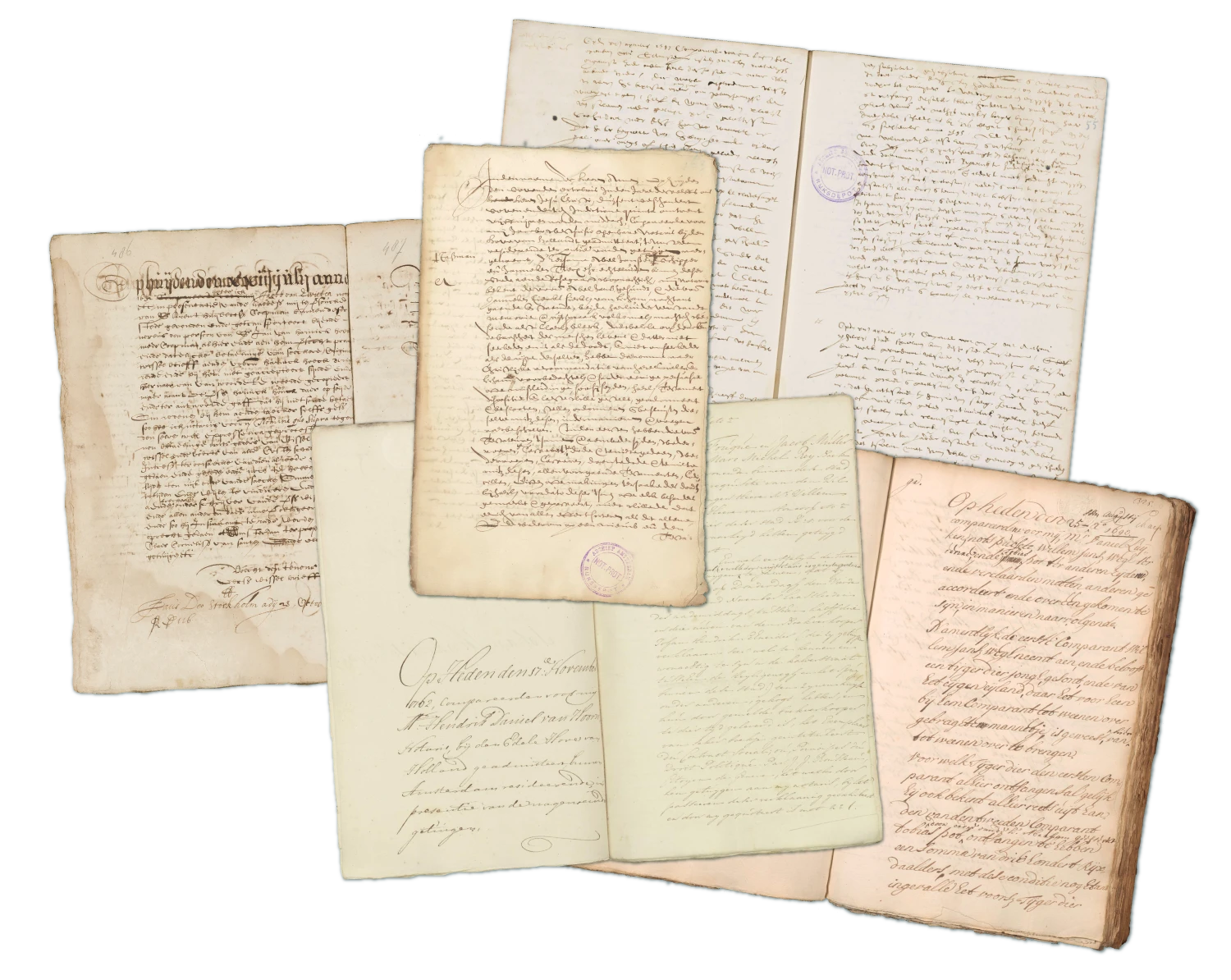
1597 - Teaching contract for Jan Pieterszoon Sweelinck by notary Lieven Heijlink
Studying under Jan Pieterszoon Sweelinck
12 April 1597, inv.no. 5075-51, fol. 54 v
In 1597, Amsterdam merchant Fernando Oyens signed a contract with Jan Pieterszoon Sweelinck for him to give harpsichord lessons to his daughters Catharina and Anneke Oyens.
Sweelinck (1562-1621) had already gained international fame in his time. He composed music for keyboard instruments and organs as well as secular and religious songs. As the city organist of Amsterdam, for many years he played the organ at the Oude Kerk.
Students came from near and far to study under him – the man also known as the Orpheus of Amsterdam – not only the organ but also the harpsichord.The great interest in Dutch paintings stands in sharp contrast to the lack of attention given to the history of Dutch music. Jan Pieterszoon Sweelinck is one of the rare well-known Dutch musicians. He was rediscovered in the 19th century when there was a need for our ‘own’ Northern-Dutch heroes, such as painter Rembrandt and writer Joost van den Vondel.
At present, the international importance of Sweelinck is generally recognized. Thanks to his many German students he had a strong influence on the development of organ and harpsichord music in northern Germany. In the 19th century Sweelinck was even acknowledged as the founder of modern instrumental music and as the spiritual father of Bach and Händel.
1632 - Statement regarding Rembrandt by notary Jacob van Zwieten
Rembrandt in good health
26 July 1632, inv.no. 5075-861, fols. 244v-245r
In 1631 Rembrandt, together with 99 other men, invested in a tontine. A tontine is a financial construction whereby a group of people put money into a fund that was then used for lucrative investments. When one of the investors dies, his part of the dividend is shared amongst the others, until such time as there is only one survivor who then receives everything in the end. Each year, a notary would check if the participants were still alive.
On 26 July 1632, notary Jacob van Zwieten went to the house of art dealer Hendrick van Uylenburgh. Rembrandt lived there and ran his workshop for 4 years, as Uylenburg dealt not only in old artwork but also had a workshop at home producing paintings and prints for sale.
When Van Zwieten rang the bell, a young girl opened the door and when he asked if Rembrandt was there, she went to fetch him. Van Zwieten noted that Rembrandt seemed fresh and snappy. Rembrandt answered: “That is so. I am, praise the Lord, fit and in good health.” The notary literally copied those words in the statement of his visit. This may very well be the sole existing literal quote from the great master of our Golden Age that was preserved.
1637 - Testament of Abel Tasman
Abel Janszoon Tasman (Lutjegast, 1603 – Batavia, 10 October 1659) was at the time working for the Dutch East India Company (VOC). His mission was to explore the country that was largely unknown to the Republic of the Seven United Netherlands in the 17th century. In 1642, for example, he was the first European to visit New Zealand and the island of Tasmania, which was named after him.
Abel Tasman appeared in 1637 in front of Jaco Jansz. Westfrisius, between 1612 and 1654 notary in Amsterdam to draw up his will. In 1657, two years before his passing he had a new will drawn up in Batavia, now Jakarta.
Act from the Amsterdam City Archives under: JACOB JANSZ WESTFRISIUS 1612-1654 – 5 – 537 – (1637-1637) – NOTA00076000206 – NOTA00076000207
1762 - Statement regarding illegal printing of Rousseau’s work by notary Hendrik Daniël van Hoorn
Illegal reprinting of work by Jean-Jacques Rousseau
inv.no. 5075-14260, 17 November 1762, deed no. 140
Amsterdam was a European center for book printing in the 17th and 18th centuries. French books were printed in great numbers. What was banned in France appeared in Amsterdam. In those books new ideas were exposed which, in the end, would lead to drastic changes in France. Descartes, Pascal, Bayle, Voltaire, Diderot, de Montesquieu and Rousseau all published their work in Amsterdam first.
Marc Michel Reij, a descendant of the Huguenots who had fled to Geneva, established himself in Amsterdam in 1746 as a book dealer and printer on the Kalverstraat. He became famous thanks to his first publications of the work of Jean Jacques Rousseau in the 1760s. He also befriended Rousseau who was a witness at the baptism of one of his children.
On 17 November 1762, Reij testified, with two other witnesses, before notary Hendrik Daniël van Hoorn. On the statement was written “for the chief officer”, which meant that legal action was going to follow. The gentlemen stated that on 4 November, between 2.30 and 3.00pm, they had purchased three books by Rousseau from book dealer Johan Hendrik Schneider on the Kalverstraat: ‘Du contract Social’, ‘La nouvelle Héloïse’ and the ‘Oeuvres Diverses’.
On the title pages it is indicated that these books were printed by Marc Michel Reij. However, this is not so. They are illegal prints/copies. Reij subsequently showed the entitlement he had obtained from the State of Holland and West Friesland to publish two of the three books.In those days, if you wished to begin a lawsuit in the Netherlands, you would usually have to testify before a notary about the offense in question. Whether or not this particular testimony led to a case against Schneider is not known.
1960 - Transportation of a tiger from Amsterdam to Vienna
In 1690 Daniel Luijken, notary in Amsterdam, received Willem Jansz Wegh and Tobias Pot in his office. The notary drew up an agreement in which the partners made an agreement about the transport of a tiger (“jongh en gesont”) from Amsterdam to Vienna.
Van der Wegh is commited to take care of the tiger, maintain it and bring it to Vienna. Pot promises to pay the amount of 300 rijksdaalder for this service. Van der Wegh was probably illiterate, because there is a cross next to his name. This notarial deed delivered legal clarity and thus certainty to both parties.Deed from the Amsterdam City Archives under:
DANIEL LUIJKEN 1685‑1699 – 5605 – (1689‑1691) – KLAL07625000256
and DANIEL LUIJKEN 1685‑1699 – 3 – 5605 – (1689‑1691) – KLAL07625000254