Spain
1504 - Will of Queen Isabella the Catholic
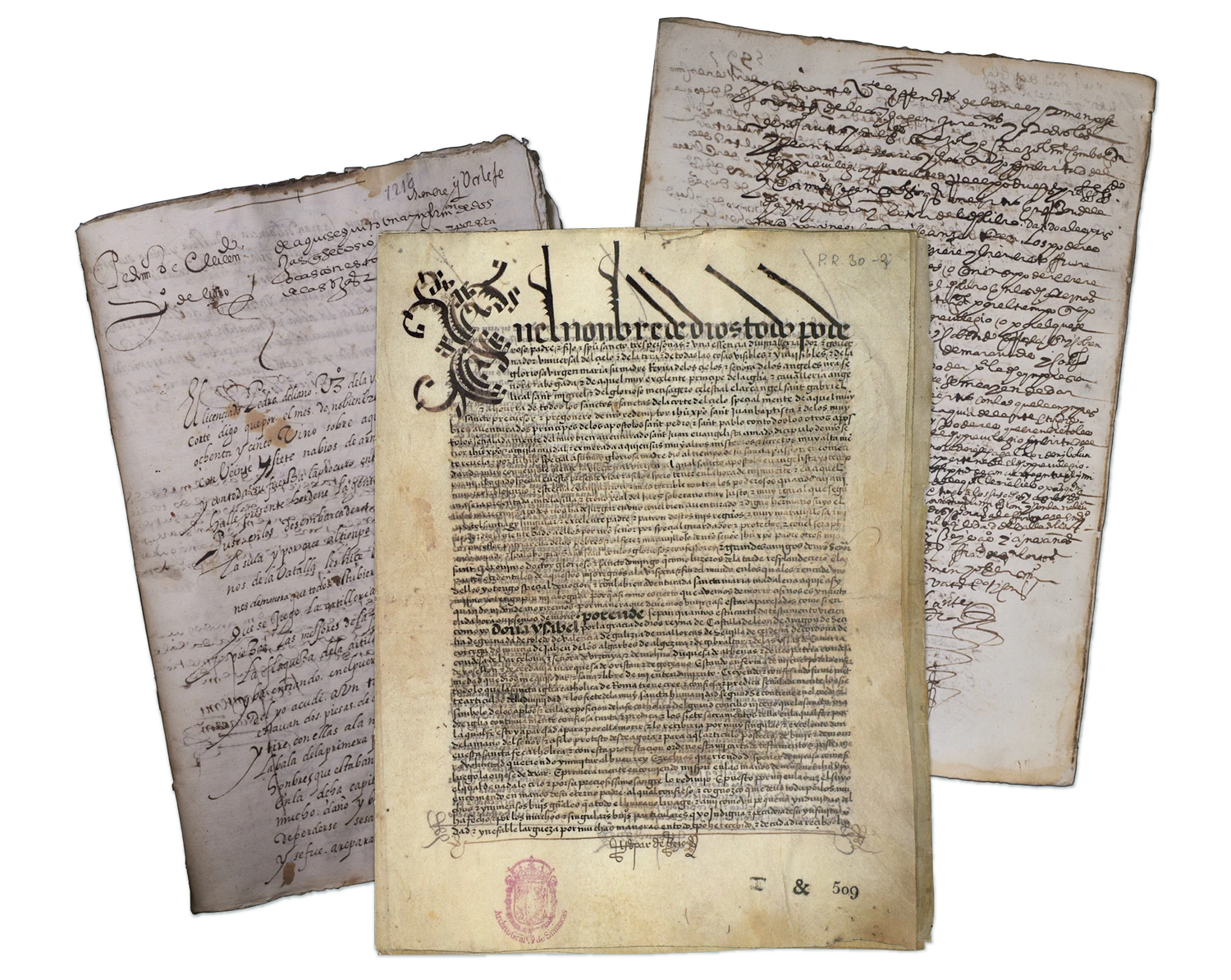
Queen Isabella I of Castile made her sole and final will and testament on 12 October 1504, when she was seriously ill at the Potrillo Palace, located in the Plaza Mayor in Medina del Campo (Castile), just forty-five days before her death. The will was authorised by the notary Gaspar de Grizio, whose intervention guaranteed the validity and legal authenticity of the document.
When she made her will, the Queen had already lost two of her sons and only her daughters Juana, María and Catalina were still alive. Her intention was clear: to establish her daughter Juana as the sole heir of Castile, in accordance with the principle of primogeniture. However, in order to achieve this, she had to overcome the obstacle of the Castilian law on legitimate shares of an estate, which at that time comprised four-fifths of the inheritance and therefore benefited Maria and Catherine.
The Queen, advised by the notary, resolved this difficulty with a clause characterised by great legal acumen: she deducted the substantial dowries that she had given her two daughters who were not heirs at the time of their respective marriages from their share. In this way, she honoured both their rights to succession, and – at the same time – prevented the division of the kingdom, which passed to Juana in its entirety.
Twelve years after Isabella’s death, the clause was practically copied by her husband Ferdinand II of Aragon in his will, witnessed by the notary Miguel Velázquez. This made the union of the kingdoms of Castile and Aragon in the person of Juana possible. Both notarial wills played a crucial role in the legal and political shaping of the modern Spanish State.
Spain. Ministry of Culture and Sports. Archivo General de Simancas. PTR,LEG, 30, DOC.2
1587 - Notarial act regarding privateer Francis Drake's attack on the island of La Palma
Notarial deed relating to the siege by Francis Drake of the island of La Palma on 13 November 1585: Request for information made by the lawyer Pedro de Liaño on the attack by the corsair Francisco Drake on the island (Madrid 19 December 1587) before the notary public of the town and court, Francisco Suárez.
Historical Archive of Protocols of Madrid. Madrid’s community. Volume 1175, folios 1210 r-1216 v.
1605 - Power of attorney granted by Miguel de Cervantes in order to file legal proceedings against those who printed or attempted to print "El Quijote”
How simple and secure the world appears in the pages of a notarial document! Who would believe that behind those simple lines, signatures and stamps lies the very framework, the inner workings of history? And yet, of course, it is true.
There can be no better chronicle of this history than notarial archives, which record each and every moment, such as the power of attorney granted by Miguel de Cervantes in order to file legal proceedings against those who printed or attempted to print his novel “El Quijote” in Castile or Portugal.
Historical Archive of Protocols of Madrid. Madrid’s community. Volume 1665, folios 559 r.- 559 v.