Poland
1411 - First peace of Toruń
On 1 February 1411, Henryk de Plauen, Grand Master of the Teutonic Order, concluded peace in Toruń with Ladislas, King of Poland, and Alexander Witold, Grand Duke of Lithuania.
The first peace of Toruń put an end to the so-called Great War of 1409-1411. Although the First Peace of Toruń did not bring lasting peace, it was of great importance for Ladislas Jagiellon’s position on the international scene. As a result of this peace, in March 1412, Sigismund of Luxembourg and Ladislas Jagiellon signed a peace treaty in Stára Ľubovňa which established Jagiellon as a Christian sovereign and ended the Hungaro-Tutonic alliance surrounding Poland.
1434 - Five notaries issued in Basel the document in which the Council of Basel asked the Bishop of Lodi to acquire information relating to the dispute between the Archbishop and the Riga Chapter and the Teutonic Order of Livonia, which had imposed the rule of the German Order on the Riga Chapter, in accordance with the rules of Saint Augustine
On 6 March 1434
The document deals with the more than 200-year conflict between the archbishops of Riga and the Teutonic order. The conflict was caused by attempts by the Teutonic order to seize power in Riga, following which, in 1297, the Riga bourgeois demolished the Teutonic court and killed the garrison in the square. In the following years, the city passed from hand to hand, until Riga became a Lutheran city in 1521-1524.
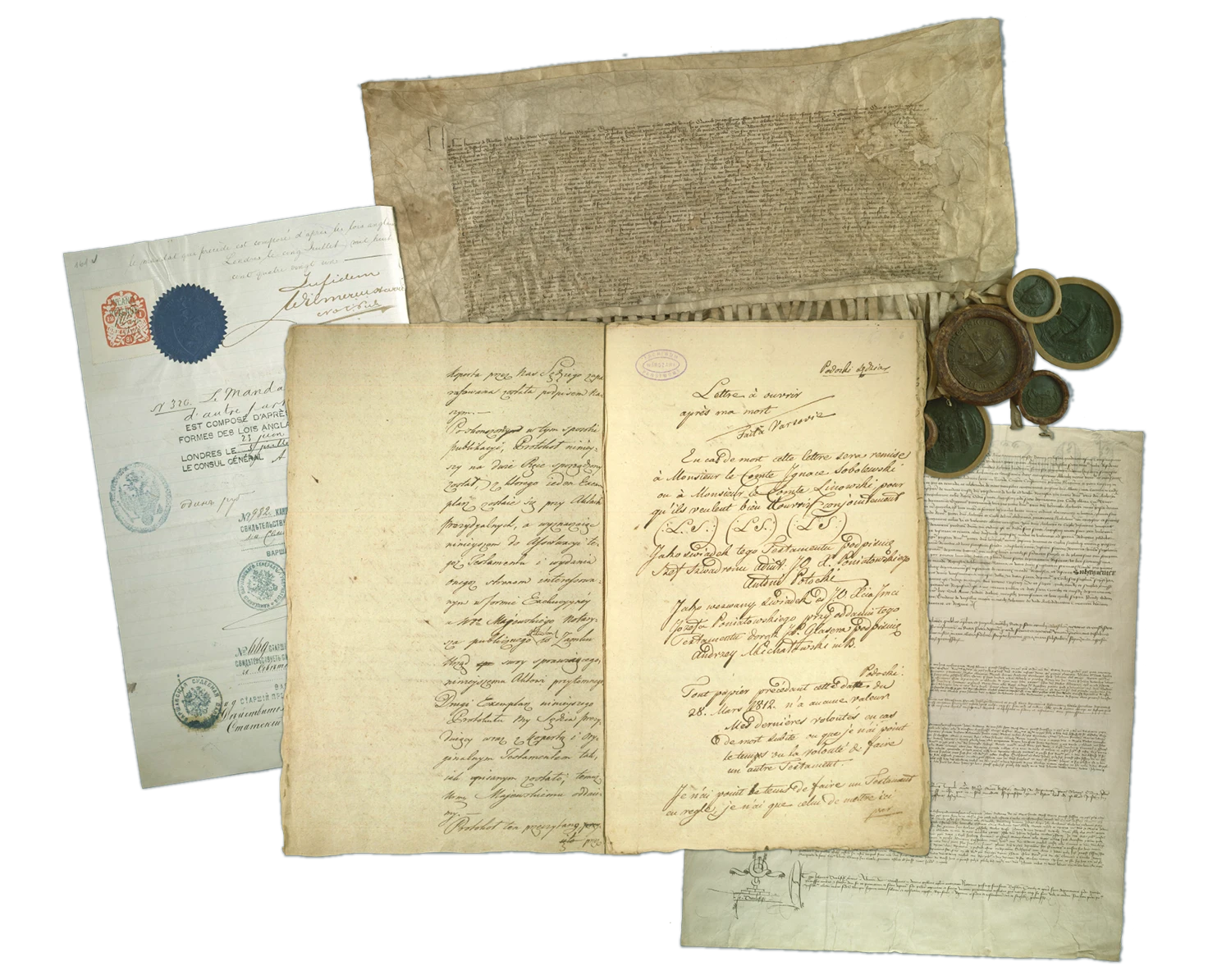
1812 - Last will and testament of Józef Antoni Poniatowski
Józef Antoni Poniatowski, Prince of the Ciołek coat of arms (born 7 May 1763 in Vienna, died 19 October 1813 near Leipzig), Polish general, Minister of War, Commander-in-Chief of the Polish Army of the Duchy of Warsaw, Marshal of France, aristocrat, freemason, nephew of the last Polish King, Stanisław August Poniatowski.
In the face of imminent war, Prince Józef, ‘in the manner of a prudent knight’, drew up his last will and testament in June 1812. He wrote the will himself, in French. Upon his departure from Warsaw, he deposited the will with a trusted official, in the presence of two witnesses, instructing that after his death, the will be given to the designated persons. After the official confirmation of Prince Józef’s death, the will was opened and announced, as designated by the Court, on 3 December 1813. The procedure was carried out in the courtroom of the Warsaw Court, in the presence of a judge, the custodian of the will, a witness who had signed the envelope in which the will was kept, a notary appointed by the court as guardian of the absent heirs, and a notary who dealt with the succession case. After removing the seal, the will was taken out of the envelope, each page and the envelope were initialled by the judge, and after reading the document, it was handed over to the notary for safekeeping, together with the opening protocol. The original will was preserved in the estate archives of Prince Józef Poniatowski and Countess Teresa Tyszkiewiczowa.
Prince Józef revoked all previous wills. He appointed his only sister, Teresa Countess Tyszkiewiczowa, as his universal heir. Prince Józef’s intention was probably known to his sister Teresa, who had been living in Paris for several years, in an informal relationship with Charles-Maurice de Talleyrand-Périgord. The lack of proper supervision led to a series of lawsuits with both creditors of the estate and individuals who appropriated items belonging to the estate.
Prince Józef did not forget about other distant members of his family, his two illegitimate sons, his comrades-in-arms and servants, for whom he provided bequests and wages. Finally, he also provided alms for the beggars of Warsaw.
The State Archive in Warsaw, Notary’s Office of Walenty Skorochód-Majewski
1881 - Authorisation by William Lindley for his son, William Heerlein Lindley, of 5 July 1881, to sign the contract with the City Council of Warsaw for the construction of a water supply network and sewerage system in Warsaw
William Lindley (born 7 September 1808 in London, died 22 May 1900 in Blackheath) – British engineer.
Together with his sons, he designed and built railway lines, sewerage and water supply networks in about 30 European cities, including Warsaw, Hamburg, Basel and St Petersburg. His projects, influenced by the ideas of English social reformer and sanitary activist Edwin Chadwick, included the first underground sewers of the modern era on the European continent. As far as international trade is concerned, the document presented contains interesting legalisations that are rarely used today.