Italy
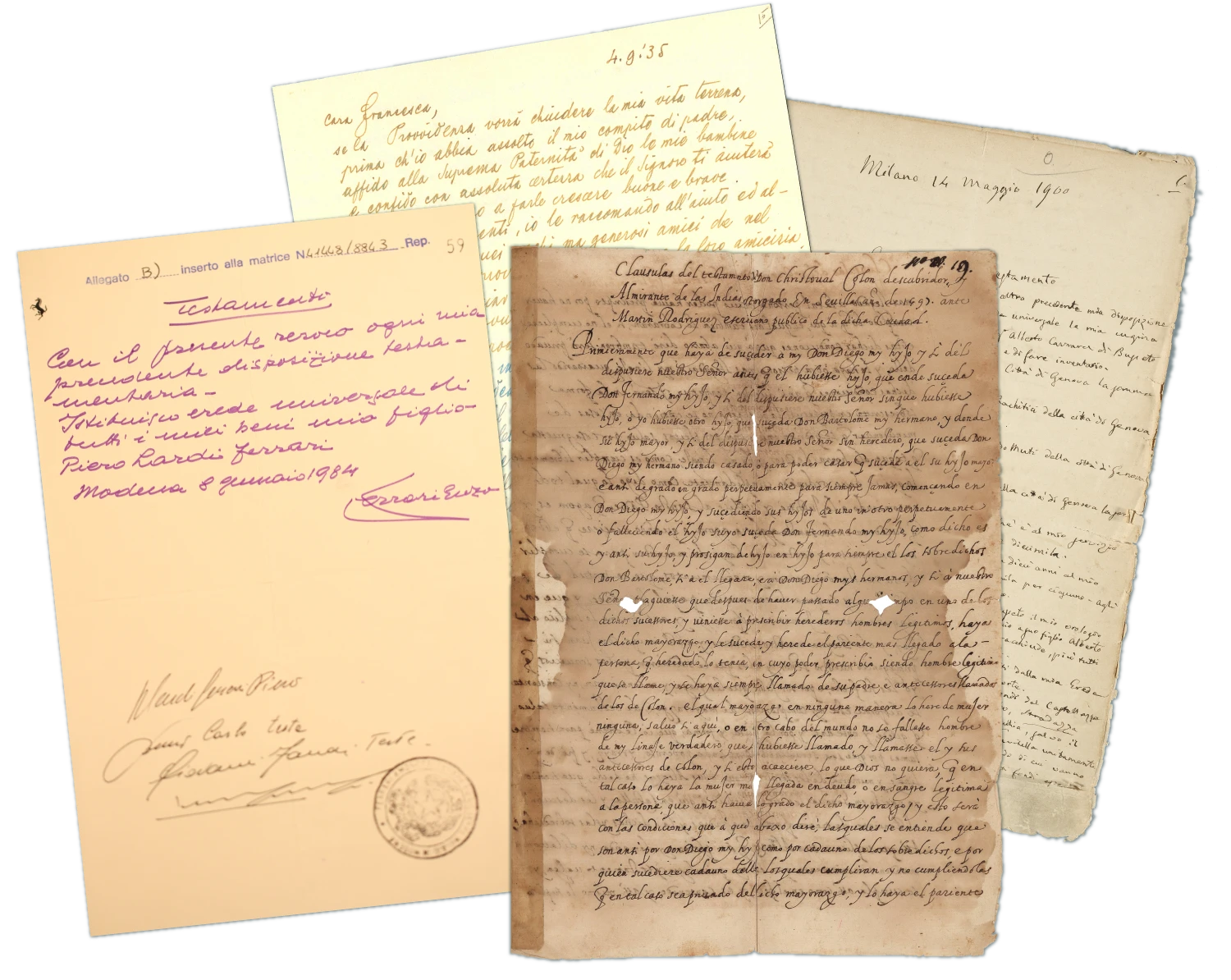
1498 - Testament drawn up by Christopher Columbus
Christopher Columbus was a navigator who changed the history of the world forever. Columbus was not only a sailor, but also a man driven by a revolutionary idea: reach the East Indies by sailing west, crossing the Atlantic Ocean.
After years of attempts and refusals, he won the support of Queen Isabella of Castile and King Ferdinand of Aragon. On 3 August 1492 he sailed from Palos de la Frontera with three ships: the Niña, the Pinta and the Santa María. On 12 October of the same year, he approached an island in the Bahamas, marking the beginning of a historic meeting between two previously separate worlds.
His venture did not signify the ‘discovery’ of America – lands already inhabited by rich and complex civilizations – but represented the starting point of a new era of global contacts, exchanges and transformations. Columbus made a total of four trips across the Atlantic, opening routes that would foster European expansion and the birth of an interconnected world.
His adventure marked the beginning of globalisation, forever changing the geography, economy and cultures of the planet.
In his will, written on 22 February 1498 in what is now Panama, he wrote: “Siendo yo nacido in Genova”, i.e. “being born in Genoa”, explicitly declaring to be “Genoese”. With these words, he raised an ancient doubt, claiming his ligurian origins and linking them forever to one of the most extraordinary adventures in universal history.
Genoa State Archives – Secret Archives, 1649, No 19
1900 - Will of Giuseppe Verdi
Giuseppe Verdi was born in Roncole di Busseto on 10 October 1813. He is universally recognised as one of the most important composers of opera. Verdi sympathised with the Risorgimento movement, which pursued the unification of Italy and actively participated for a short period in political life (he was a senator of the Kingdom of Italy), becoming a profound artistic symbol of the country’s unity. He died in 1901, and without direct heirs and as the owner of a huge estate, he drew up a long list of people and institutions to benefit from his legacy for social pruposes. These include: the central kindergartens, institutions for the malnourished, the deaf and dumb, the blind of Genoa; the hospital of Villanova sull’Arda; the Mount of Piety in Busseto; the Casa di Riposo per Musicisti retirement home for retired musicians, built by him, to which he gave 75 thousand lire in income and all the copyright in Italy and abroad on all his works.
Notarial Archive of Parma – Holographic will dated 14 May 1900.
Notary Angiolo Carrara of 27.01.1901 directory no. 2.613.
1935 - Will of Alcide De Gasperi
Alcide De Gasperi was born in Pieve Tesino (Trento) on 3 April 1881. He was one of the protagonists in the political and economic reconstruction of Italy after the Second World War and was head of centrist governments from 1947. He is considered as one of the fathers of the Republic (he was a minister several times then President of the Council) and of the future European Union. His foreign policy (he was Minister of Foreign Affairs and President of the ECSC) was aimed at including Italy in the Atlantic Alliance and achieving a united Europe.
Historical Archive of the Alcide De Gasperi Foundation – Rome.
1984 - Will of Enzo Ferrari
Enzo Ferrari (Modena, 1898 – Modena, 1988) is one of the best‑known and most influential Italian figures of the twentieth century. Founder of Ferrari, a brand that has become a global icon, he succeeded in transforming his passion for engines into a symbol of excellence, innovation and style recognised worldwide. His life, deeply connected to the city of Modena, was marked by discipline, determination and a unique vision that gave rise to a legend transcending the world of motor racing and entering the collective imagination as an expression of Italian talent and creativity.
This exhibition presents a rare and highly significant document: the will of Enzo Ferrari. It is a deliberately essential text, composed of a few clear and direct lines that reflect its author’s pragmatic and reserved character. There are no unnecessary explanations or emphasis—only the necessary provisions, entrusted to the precision of the written word.
What makes the document even more special is its material and symbolic value. The will is written on headed paper and is signed and written with Enzo Ferrari’s famous purple pen, an object that has become an integral part of his public image. Through this document, visitors are invited to encounter a more intimate dimension of Ferrari’s founder, discovering how even in the final act of his life, coherence, sobriety and a sense of responsibility emerge.